For the better part of three years, Melbourne has been the capital city everyone left off the highlight reel. Brisbane, Perth and Adelaide ran hard. Melbourne sat still. Higher holding costs, an investor exodus, more stock sitting on the market and softer sentiment all landed at once.
So when clients ask us whether Melbourne will recover, we tell them that’s the wrong question. The more useful one is this: what happens to a market that’s been overlooked for years while its underlying fundamentals quietly stayed intact?
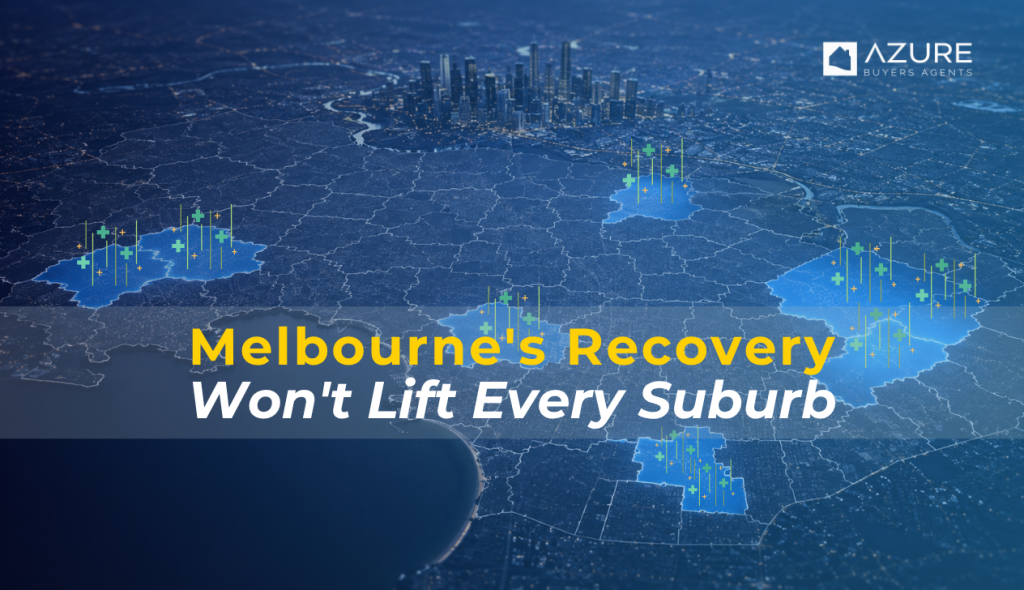
Here’s the part the headlines miss. Melbourne isn’t one market. It’s dozens of distinct submarkets, each with its own buyers, its own level of demand and its own long-term drivers. A recovery never arrives evenly across them. Some suburbs will attract real competition early. Others will keep lagging no matter what the wider city does. The gap between those two outcomes usually comes down to fundamentals that were in place long before any recovery began.
So the question we ask isn’t “will Melbourne recover?” It’s “which parts of Melbourne are built to benefit when it does?” Here’s how we answer that for our clients.
Location Beats Timing
Buyers often obsess over timing the bottom. In practice, location selection decides far more. Across every Melbourne cycle, some suburbs surge while their neighbours barely move under the exact same conditions. The variable is demand, and not the six-month kind driven by sentiment and headlines. We’re talking about the durable kind that shows up year after year. Four things tend to drive it.
1. Owner-Occupier Demand Sets the Floor
Are people buying in an area because they want to live there, or because investors are chasing a number? Suburbs with genuine owner-occupier appeal hold up better when sentiment softens, because the reasons people buy there don’t evaporate with the cycle. Cotality data consistently shows owner-occupier-heavy suburbs recording steadier price performance through downturns than investor-heavy ones. Families still want schools. Professionals still want a reasonable commute. People still want parks, cafes, transport and a sense of community. That’s what puts a stronger floor under prices when the market gets nervous.
2. School Zones Are the Most Reliable Demand on the Map
If one buyer group rarely disappears, it’s parents. Families will stretch a budget, compromise on the house and widen the search radius to stay inside a preferred catchment. REIV research has found some Melbourne school zones command premiums of several hundred thousand dollars over near-identical homes just outside the catchment. A decade-long life decision drives that demand, not a market mood. That’s why family suburbs keep drawing competition even when everything around them feels uncertain.
3. Land Is the One Thing They Cannot Make More Of
Infrastructure improves and neighbourhoods change, but land within roughly 15 to 25 kilometres of the CBD stays finite. As Melbourne’s population keeps growing, according to ABS population data, scarcity does more of the work. This isn’t an argument that every block beats every apartment. It’s that meaningful land content carries a scarcity premium higher density simply cannot replicate, and over long horizons that premium compounds.
4. Infrastructure Prices in Tomorrow’s Convenience
Most buyers value a suburb on what it looks like today. We think the stronger play is often what it’s becoming. Infrastructure Victoria’s research on major transport projects shows how upgrades reshape access to jobs and services well beyond their immediate corridor. Transport upgrades, new precincts and better connectivity reshape demand, and the suburbs gaining connections now are frequently the ones whose convenience premium gets priced in later. Not every project delivers, so the skill is reading which changes will actually change how people live, commute and spend their time there.
The Ripple Effect Most Buyers Walk Past
When buyers get priced out of a premium suburb, they rarely leave the area. They move one or two suburbs further out to hold onto a similar lifestyle, commute or school access. AHURI research has confirmed this ripple effect across multiple Australian housing submarkets. That spillover lifts the neighbours. We’ve watched it play out across Bayside, the inner east, the inner north and parts of the west over multiple cycles. The strongest opportunity is often not the suburb everyone is naming. It’s the one sitting right beside it.
Where These Fundamentals Line Up Today
Bayside still has the owner-occupier demand, lifestyle pull and long-term scarcity we look for. The inner east holds its established school zones, transport access and steady family demand. Pockets of the inner north and west keep attracting buyers who want connectivity and lifestyle at a relative discount to the premium suburbs next door.
None of that makes every listing in those areas a good buy. It means the underlying drivers of demand are intact, and that’s where we prefer to focus our search.
Cheap and Value Are Not the Same Thing
This is exactly where buyers get caught out in a market like this one. A soft market produces a lot of low numbers, and a low number isn’t the same as value. Value comes from long-term fundamentals. Cheap is just a smaller figure on the contract.
Some things stay cheap for reasons that won’t change: a compromised location, a difficult layout, a structural problem that limits who will ever want to buy it next. Oversupplied apartment markets can keep struggling as more stock arrives. Some outer growth corridors are still waiting on infrastructure that population growth has already outrun. In a recovery, the discipline isn’t hunting for the cheapest thing on the market. It’s refusing to confuse the two.
Our Bottom Line
Melbourne’s recovery won’t be uniform. It never is. The suburbs that perform over time are usually supported by the same things that supported them years ago: owner-occupier demand, quality amenity, access to schools, scarcity, connectivity and lasting desirability.
Our job isn’t deciding whether Melbourne is a good market. It’s identifying which parts of it are positioned to benefit from those drivers, then filtering hard enough to act with conviction while everyone else waits for a headline to give them permission. That’s usually the difference between buying a property and making a decision you’ll still feel good about years from now.
Thinking About Buying in Melbourne?
Knowing Melbourne will recover is one thing. Knowing which suburbs, and which streets within them, are positioned to benefit first is another. That’s where a safe pair of hands and strategic advocacy make the difference.
Get in touch with Team Azure to talk through your search.